PORTRAITS AS MEANS OF COMPARISON
These artists are using comparative portraiture to describe what has happened between shots. These works frequently focus on visualizing the impact something external had on the subject. By looking at the “before and after” the unseen space in between can be alluded to.
Before and After
Danish artist Nicolai Howalt created a series of boxers’ portraits, taken before and after a fight.


Faces of Meth
Faces of Meth is a drug education and prevention project run by the Multnomah County Sheriff’s Office in Oregon. The project uses mugshots of repeat offenders to demonstrate the harmful and damaging effects of methamphetamine on its users. Deputy Bret King and his co-workers collected images of people charged with crimes related to methamphetamine addiction to document the change in physical appearance over time due to the use of the drug.


The Brown Sisters
Every year for the past 40 years, Nicholas Nixon has photographed the four Brown sisters. The work depicts differentials of time, and between siblings. Video • New York Times article


Becoming Mel
A series of self-portraits shows photographer Mel Keiser upon waking, and then after she’s readied herself to face the world. “The first picture is taken immediately upon waking, before I have a mental concept of my identity or self-image,” says Keiser, “The second picture is taken after I begin to feel like ‘Mel,’ usually after my physical self begins to reflect what I believe ‘Mel’ looks like.”


We Are Not Dead
Photographer Lalage Snow’s We Are Not Dead series visually depicts the state of mind soldiers found themselves in before, during, and after their operational tours in Afghanistan. Taken over a period of eight months, each individual was photographed on three separate occasions. The first photos were taken before heading to Afghanistan, the middle photographs were taken during the tour, and the final shots were taken once the subject had returned home.


National Geographic: Twins
In January 2012, National Geographic published an article and portrait series that compared sets of identical twins. The photographer, Martin Schoeller, shot each set of twins in identical clothing, with the same lighting, and from the same angle. Both the article and photos sought to explore how and why twins differ despite sharing identical genetic makeup.


Faces Under Reflection
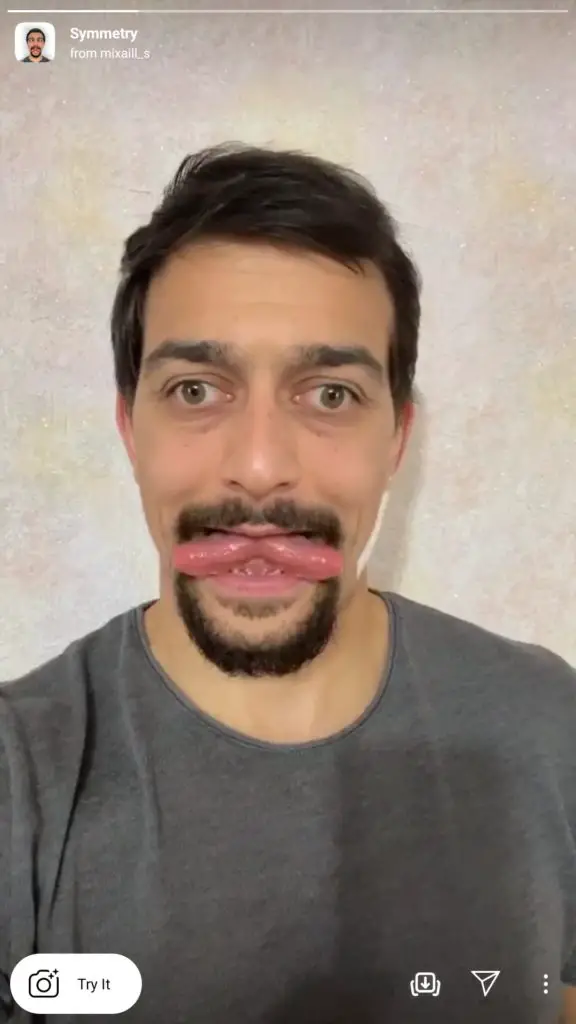
Transformations can be purely formal. This series by Alex Beck and this related work by Julian Wolkenstein shows how different people’s faces appear when mirrored.


Mirror Filters

Re-staging Old Images


While small multiples are generally ordered in space, they can also be ordered by time, as in this extreme 16-year time lapse by artist JK Keller:

Portraits as a Collection
Artist have designed a system or set of rules for capturing a series of portraits. d
More Turns

Bill Sullivan’s More Turns (2006) is a highly controlled photographic study of people passing through subway turnstiles. Sullivan equalizes his subjects by capturing all of them in the same action and from the same distance.

Sullivan writes:
“I needed something to be objective: I wanted the context to be clearly established. I wanted play a role in the situation, but I wanted the situation to take a photograph of itself for me. I would design the scenarios in which this could happen, and then the situation could be responsible for creating the picture. The poetry would be as much in the design of that scenario as from any photograph that might come from it. These situations would include me but I would disappear as any kind of typical photographer. I would simply play a role in the scenario. I would become someone waiting for an elevator, a man reading the New Yorker waiting for a friend to pass through the turnstile, or simply another tourist watching someone having his or her portrait done. The situations were mapped out, tests were made, and special clothing was worn. I became a spy for the obvious. I developed a situation so that various subjects could be defined by the constraints of exactly the same mechanical apparatus. The scenario consisted of someone passing through a subway turnstile. At the moment that the subjects passed through the turnstile, unknown to them, I took their picture stationed at a distance of eleven feet. I stood there turning pages of a magazine observing subjects out of the corner of my eye, waiting for only the moment when they pushed the turnstile bar to release the shutter.” (Via MoMA)
Ten Meter Tower
Maximilien van Aertryck and Axel Danielson, Ten Meter Tower (2017)
“Our objective in making this film was something of a psychology experiment: We sought to capture people facing a difficult situation, to make a portrait of humans in doubt. We’ve all seen actors playing doubt in fiction films, but we have few true images of the feeling in documentaries. To make them, we decided to put people in a situation powerful enough not to need any classic narrative framework. A high dive seemed like the perfect scenario.“

People Staring at Computers
“People Staring at Computers” (2011) was a photographic intervention by Kyle McDonald that pushed the legal limits of candid photography in commercially-controlled commercial spaces.
McDonald wrote an simple application that took one picture every minute. If it found a face, it uploaded the photo to his server. He installed the app in Apple stores around NYC over three days, collecting more than a thousand photos.

- I wasn’t expecting the Secret Service” article in WIRED
Shooter
Beate Geissler & Oliver Sann, Shooter (2000)
The title of each photograph is a combination of the name the gamer had given themselves and their individual pulse frequency in the moment the picture was taken.
Big Drozdowski, 115 (left). Kai, 115 (right).
“The photographs are taken in the very moment the depicted person is killing an opponent in the computer game. According to the artists, ‘The viewer witnesses a life-and-death game with no consequences’. ‘shooter’ presents a test set-up with which to analyse the human relation to real and virtual spaces and the associated gestures and facial expressions.“

STOP, Dread Scott (2012)
2-channel HD projected video, Running time 7:16, 2012 Stop is a 2-channel projected HD video installation. The videos are projected on two opposite walls. One projection features young men from East New York Brooklyn, the other, young men from Liverpool UK, each of whom have been stopped numerous times by the police. In the video each repeatedly states the number of times they have been stopped. Stop was created as part of Postcode Criminals, a collaboration between Dread Scott, Joanne Kushner and young adults form Brooklyn, NY and Liverpool, UK. In 1996 NY police chief William Bratton met with his counterpart Ray Mallon in the UK to share zero tolerance policing strategy. The result was that youth in Liverpool and in New York were further criminalized and have been drawn into an unusual symmetry by police and governmental forces. Postcode addresses the effects of police intervention in their lives and their communities.
The Stun Gun Photoshoot
Patrick Hall’s Stun Gun Photoshoot is a photo series showcasing the various emotions and reactions of people at the moment they are hit with a 300,000 volt stun gun. Hall’s approach elicits utterly candid reactions ranging, interestingly, from pain to pleasure.

Emoticam
Emoticam by Dan Sakamoto .
Emoticam is a program running (consensually) in the background of people’s computers.
Anytime a user types something to imply they’re emoting in real life, it takes a photo of their face and uploads it here and to Twitter.
Emoticam is open participation; you can download the software here.


Shoot an Iraqi – Wafaa Bilal
Indirect portrait using physical objects
Portrait of Ross
Untitled (Portrait of Ross in L.A.) (1991), by Felix Gonzalez-Torres, is an allegorical representation of the artist’s partner, Ross Laycock, who died of an AIDS-related illness in 1991. The installation is comprised of 175 pounds of candy, corresponding to Ross’s body weight before becoming ill. Viewers are encouraged to take a piece of candy, and the diminishing amount parallels Ross’s weight loss and suffering prior to his death.

Library of Dust

David Maisel’s Library of Dust depicts approximately 3,500 individual copper canisters, each containing the cremated remains of patient from a state-run psychiatric hospital. The patients died at the hospital between 1883 and the 1970’s; their bodies have remained unclaimed by their families.
Lipsticks
Stacy Greene’s Lipsticks (1992), per the artist,
“are a series color close-ups of used lipsticks, with each print titled with the name of the lipstick’s owner. They are distinguished by their striking variations in form and texture arising from the owners’ individual techniques of application. The everyday, factory, ‘ready-made’ product turned into a uniquely surreal and subconscious image – a sculpture evolving from a private daily ritual taken for granted. A personal object/process that reveals , through colors and shapes, a relationship of imprint at the periphery of the body.”

The Hotel
For her photo series, The Hotel (1981), Sophie Calle posed as a chambermaid in order to take photos of hotel rooms, as proxies for their inhabitants.

“Sophie Calle’s voyeuristic fascination with the lives of others inspired The Hotel, a project she executed in the early 1980s while posing as a chambermaid at a hotel in Venice, Italy. Each work in the series is a portrait of a room she was assigned to clean, including photographs of the bed and personal belongings she found there, and a text by the artist offering her imaginative impression of the absent guests.”
- More information about Sophie Calle’s hotel rooms
Photos from CPB
t. Each one was left behind by a migrant processed at an Arizona Customs and Border Protection facility where photographer, Tom Kiefer, worked as a part-time janitor for 11 years, much of it spent diligently rescuing these objects from the trash.

Material World
In the Material World: A Global Family Portrait photo series (1994), Peter Menzel and other photographers took portraits of 30 statistically average families — with all of their worldly possessions displayed outside their homes.


Toy Stories
For Toy Stories, over two years, photographer Gabriele Galimbert
visited more than 50 countries and created colorful images of boys and girls in their homes and neighborhoods with their most prized possessions: their toys. From Texas to India, Malawi to China, Iceland, Morocco, and Fiji, I recorded the spontaneous and natural joy that unites kids despite their diverse backgrounds. Whether the child owns a veritable fleet of miniature cars or a single stuffed monkey, the pride that they have is moving, funny, and thought provoking.


Girls of the Internet Museum
https://gim-museum.tumblr.com/ Founded in 2012 by Mexican artist Gaby Cepeda, GIM is a Tumblr that serves as an online institution striving to create a portrait of millennial artists as they explore girliness. GIM selects works responding to four different core ideas: sincerity, a subjective representation of the female condition, exploration of online vs. IRL representations of girliness, and the acknowledgement of the “fluidity between emotions/reality in the online/offline worlds.” GIM exists primarily online, but more recently the project has started inhabiting art galleries. I have gotten lost in the GIM Tumblr for hours looking at .gifs, video art, and digital collages.
Indirect portrait using data
Annual Reports
Nick Felton’s 10 years of Annual Reports
The tenth and final Feltron Annual Report examines the state of state of self-tracking through widely available apps and devices. When the project began in 2005, the music-tracking website Last.fm was the only service capable of automatically capturing a category of personal data. Ten years later, listening habits can be augmented with persistent location data, categories and amounts of physical activity, sleep, weight, continuous heart-rate, blood-alcohol levels, driving habits and computer usage. This report attempts to merge all of this information in a format that reveals connections, provides context and suggests correlations.


Dear Data
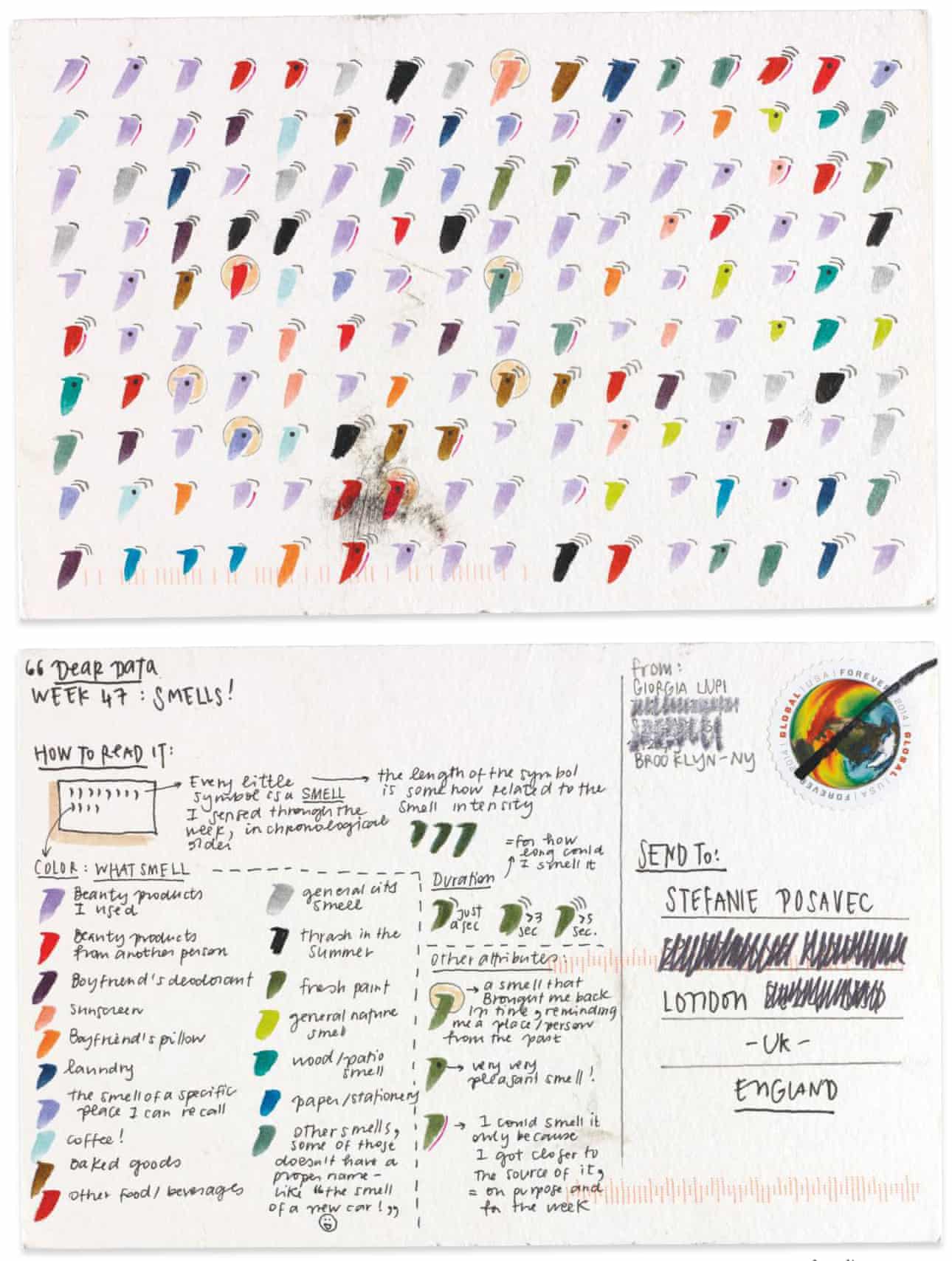
Dear Data is a year-long, analog data drawing project by Giorgia Lupi and Stefanie Posavec, two award-winning information designers living on different sides of the Atlantic.
“Each week, and for a year, we collected and measured a particular type of data about our lives, used this data to make a drawing on a postcard-sized sheet of paper, and then dropped the postcard in an English “postbox” (Stefanie) or an American “mailbox” (Giorgia)!
Eventually, the postcard arrived at the other person’s address with all the scuff marks of its journey over the ocean: a type of “slow data” transmission.”


Christine Sun Kim
Christine’s series of pie chart drawings break down the factors involved in a number of the personal decisions she makes as a Deaf person (like Why I Do Not Read Lips, and When I Pretend to Be Hearing) by relative importance. Shit Hearing People Say to Me stands apart from the eight other drawings in the series presented at the List Center. Rather than illustrating her choices, with unequal weights given to each factor in her decision, in this drawing the chart’s slices are divvied up evenly, each section representing a biased or inappropriate comment the artist has received from hearing people.


One Human Heartbeat
Every day, Jen Lowe renders a visualization with the most intimate of personal data—her heartbeat. She r
ecords her pulse with the Basis health-tracking wristwatch, then once a day uploads the information to onehumanheartbeat.com to replicate her heart, albeit on a 24-hour delay. The project is part of a larger trend toward live-updating visualizations that change in real time. A throbbing red light at the center shows her heartbeat. The outer ring counts down her (expected) days remaining on Earth.

So Sorry
By me! Claire Hentschker. The book ‘so sorry’ compiles all of the emails I sent from 2011-2016 in which the word ‘sorry’ appears at least once, in reverse chronological order. There were 214 emails that met this criterion, from two different Gmail accounts of mine. Each page of this book contains a redacted version of one of these emails, in which only the sentence that contains the apology is left visible, without its context. Each page also includes the time and date each email was sent. After I included an email in the book, I permanently deleted it from my email account.


Self-portrait by R. Luke DuBois
A data visualizations on paper, representing Dubois’ email relationships and Facebook friends.

Stranger Visions
Regarding Heather Dewey-Hagborg’s tour-de-force Stranger Visions (2013), the artist writes:
In Stranger Visions I collected hairs, chewed up gum, and cigarette butts from the streets, public bathrooms and waiting rooms of New York City. I extracted DNA from them and analyzed it to computationally generate 3d printed life size full color portraits representing what those individuals might look like, based on genomic research. Working with the traces strangers unwittingly left behind, the project was meant to call attention to the developing technology of forensic DNA phenotyping, the potential for a culture of biological surveillance, and the impulse towards genetic determinism. Video


Browser History
While a student at CMU, Shan Huang developed Quantified Selfie: Browser History Visualization* (2014), a self-portrait compiled from the favicons of the web sites she visited over a six-month period.

Data portraits in the wild
Spotify Wrapped year-in-review

“Last used Emoji Trends “


Zoom Escaper Sam LAvigne
Zoom Escaper lets you sabotage your own meetings with audio problems, crying babies, and more
/cdn.vox-cdn.com/uploads/chorus_image/image/68968533/Screen_Shot_2021_03_15_at_3.46.29_PM.0.png)
https://www.theverge.com/2021/3/15/22331744/zoom-escaper-sabotage-meetings-fake-audio-problems
ou can choose from barking dogs, construction noises, crying babies, or even subtler effects like choppy audio and unwanted echoes. Created by artist Sam Lavigne, Zoom Escaper is fantastically simple to use. All you need do is download a free bit of audio software called VB-Audio that routes your audio through the website, then change your audio input in Zoom from your microphone to VB-Audio, and play with the effects.
Additional Viewing
“Insightful human portraits made from data” by Luke DuBois
Giorgia Lupi talk at the Guggenheim
Mimi Onuoha // Steiner Lecture in Creative Inquiry, 4/24/2018
BRAINSTORMING EXERCISE
Please brainstorm a list of 10 ideas for experimental portraits and post your list as bullet points in the class chat on discord.
These can be very loose ideas, but push yourself to use the lecture as inspiration to come up with 10 ways you might approach making a series of experimental portraits that fit into one of the categories above. Each idea can be expressed in a sentence or two.
We will meet back at 1:40
 NEW LENSES: Experimental Capture and Release
Leave a comment